

Linda Heslop. 1996. 50 pp.
67 illustrations.
ISBN 0-939748-44-4 $9.95 pb (Cover)
Here are some book reviews that will tell you how our books have been received. Check back often for the latest information. Just click on any title below to go directly to reviews of that book. Click on "cover" to see a small image of the cover. Or just scroll down to read the reviews of the newest releases. All of them are great.
|
|
Alpine Karst 2004 |
Beyond Mammoth Cave |
|
Hidden Beneath the Mountains: |
|
|
Prehistoric Cavers of Mammoth Cave |
Scary Stories of Mammoth Cave |
|
True Tales of Terror in the Caves of the World |
Cave Geology |
|
The Art of Caving (Cover) |
|
|
Cave Passages: Roaming the Underground Wilderness (Cover) |
|
|
Deep Secrets: The Discovery and Exploration of Lechuguilla Cave (Cover) |
|
|
Going Under and Endurance: An Antarctic Idyll, Two Poems (a double volume) |
|
|
A Guide to Speleological Literature of the English Language 1974 -1996 (Cover) |
The Jewel Cave Adventure: Fifty Miles of Discovery Under South Dakota (Cover) |
|
Memoirs of a Speleologist: The Adventurous Life of a Famous French Cave Explorer (Cover) |
|
|
|
South China Caves (Cover) |
|
Speleology: Caves and the Cave Environment (Cover) |
Subterranean Climbers: Twelve Years in the World's Deepest Chasm |
|
Archeology of the Mammoth Cave Area (Cover) |
The Caves Beyond: The Story of the Floyd Collins' Crystal Cave Exploration (Cover) |
|
|
Rambles in the Mammoth Cave, During the Year 1844, by a Visitor (Cover) |
|
|
|
|
The Cave Research Foundation: Origins and the First Twelve Years 1957-1968 |
Wilderness Resources in Mammoth Cave National Park: A Regional Approach (Cover) |
|
Note on CRF Newsletters (in work) |
|
Cave Biology |
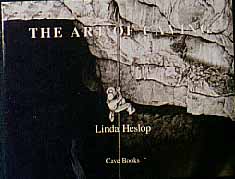
Linda Heslop. 1996. 50 pp.67 illustrations.ISBN 0-939748-44-4 $9.95 pb (Cover) |
|
The Art of Caving is a visual journey into the world of caves and those who explore and map them, through the eyes and ink of artist/illustrator, Linda Heslop.
The Art of Caving, a coffee table book, is a collection of more than sixty works compiled to take the reader on a journey down to the secret world of caves not accessible to the uninitiated explorer. It provides a window for the reader through which to view the challenges faced by those who map, work, and explore underground. Readers are taken down rope drops, across underground waterfalls, through torturous passages to vast chambers, and then to emerge once again into the world of daylight. Heslop's images include caves of Europe, USA, Mexico, and many of Vancouver Island's caves.
For more than ten years, Heslop has been a cave explorer who has discovered and mapped caves throughout western Canada and the United States. As North America's most acclaimed speleo-illustrator, she has used her dramatic representational style to illustrate several books and to provide cover art for caving magazines published worldwide.
"Linda Heslop's cave drawings . . . . are excellent, on heavy, smooth paper. This is a very nice and reasonable priced book. It would make a great gift."
So, with my pen and pencil, allow me to take you on a brief journey underground. To fellow cavers, I hope you find my way of seeing caves true to your ways. To those yet to experience a wild cave trip, here is the essence of this breed called cavers and the diversity of caves themselves. This is the glorious art of caving.
Paul Courbon, Claude Chabert, Peter Bosted, Karen Lindsley. 1989. 376 pp.ISBN 0-939748-21-50 $21.95 pb (Cover) |
 |
Atlas of the Great Caves of the World is an almanac, encyclopedia, and book of records all under one cover. It is an invaluable reference book for cave explorers and cave enthusiasts of all levels.
Contained in its 376 pages are:
"Atlas of the Great Caves of the World combines the best features of an almanac with the coverage of a special encyclopedia and an easygoing writing style to create a book that is a lot of fun to page through at the same time that it's chock-full of information . . . . it is also a very good reference book. The maps alone serve a need which many map libraries have been unable to answer . . . . It very definitely belongs in all geography and geology libraries."
"This book is . . . a catalogue of the world's greatest caves . . . Readers will inevitably feel a twinge of regional or national pride--but beneath it all there will be a deeper feeling of unity with speleologists throughout the world."
"This is a 'Guinness book of cave records' written by cave lovers for cave lovers."
"For those public and academic libraries with a clientele interested in cave exploration, this volume is well worth its $20 price."
Sheck Exley. 1994. 325 pp.16 color, 55 b/w photos, 16 maps. (Cover)ISBN 0-939748-33-9 $32.95 hbISBN 0-939748-25-8 $21.95 pbISBN 0-939748-20-7 $125.00 ltd. ed. hb |
 |
Caverns Measureless to Man is the story of the passion of an extraordinary individual who spent his life exploring underwater caves.
For nearly 30 years Sheck Exley was the leader. He set records, he developed the techniques, and he maintained the highest standards of excellence. Sheck lived a life of adventure, danger, and excitement of a degree that few people can ever dream of, or, if they do, those dreams are nightmares. If you participate on the highest level, you know that some of your best friends are going to die. If you continue to push yourself and your equipment to the limits --if you persist in being a world class diver as Sheck was-- the chances are very high that you, too, will die.
This book may terrify you, but it will unquestionably fascinate you, and in the end, Sheck Exley will convince you that his death came to him in the midst of the incredibly intense joy he took in diving into the depths of the earth.
The boxed, limited edition is printed on special paper and is numbered 1-100. Sheck was going to autograph each copy and the profits were (and still are) to be his personal contribution to the Hamilton Valley Project of the Cave Research Foundation. Alas, Sheck died four days before copies of the book were available, and he never saw it. His contribution to CRF will still be made, however, as book collectors and admirers of Sheck Exley will soon buy up this limited edition.
"Sheck Exley was at the forefront of international cave diving. He had a fascination for depth which led to his demise, at the age of 45, while attempting a new world depth record in a remote siphon in northern Mexico in 1994 . . . .
"Caverns Measureless to Man is a very readable autobiography of this exceptional man . . . . enthralling, laced with danger and excitement, yet tinged with a touch of humor.
"This is a gripping book equally appealing to the diver and non-diver alike."
"Caverns Measureless to Man is . . . . hard to put down. It begins with his . . . breaking every rule in the book--rules and books that were in many cases later written by Sheck . . . . Sheck made over 3,000 cave dives, covering over a million feet underwater . . . . This is the most important caving book published in the United States in this decade."
"Sheck Exley for almost thirty years developed the techniques and set the standards for cave divers today. Many times while reading this book I found myself holding my breath while someone was stuck in a tight spot, fighting with damaged or defective equipment, lost in a silted-up passage, or just plain running out of air . . . This book is as close as most will ever want to get to an underwater cave."
Martyn Farr, forward by Bill Stone. 1991.280 pp., 51 color, 108 b/w photos. (Cover)70 maps & illustrations.ISBN 0-939748-32-0 $37.95 hb |
 |
This profusely illustrated book, written by one of Britain's leading cave divers, is a spectacular introduction to the world's most dangerous sport.
The Darkness Beckons describes the techniques and fascinating history of cave diving from the first known cave dive in 1878 with the familiar globe shaped helmet, heavy boots, and sturdy air lines fed by surface pumps, to the sophisticated re-breather systems used by divers today. This internationally comprehensive book includes stories from the United States, France, Switzerland, the West Indies, Mexico, South Africa, UK, and Australia.
This new book includes both historical anecdotes and accounts of the most interesting recent dives. It is a chronicle of outstanding sporting endeavor, as yet little known outside an elite specialist world, but sure to inspire anyone with a taste for adventure.
"I would recommend this fine book to anyone, caver or not, who likes to read about exploration . . . . very clear writing . . . . amazingly up-to-date. The frontiers of underwater cave exploration today are as challenging, if not more so, as the conquest of the sea, the mountains, and the arctic, and the history of cave diving is happening now . . . . read this book."
PB. 24 pp., 29 color, 7 b/w photos.
6 maps & illustrations, 7 in x 9 in. $4.25 pb
CAVE BOOKS
For those that already have The Darkness Beckons the updated information is also available as a very reasonably priced supplement. The Darkness Beckons Supplement: Postscript--The 1990s continues in the tradition fans of the book have come to know: packed with high quality photos, map, charts, and a wealth of information. It brings the reader up to date with developments in cave diving from around the world, included information on Bill Stone's work in Sistema Huautla and Wakulla Springs, as well as other stories from France, UK, US, Mexico, Brazil, and South Africa. Several pages are also given to the exploration of Zacaton and a detailed report on the tragic death of Sheck Exley as he tried to penetrate its depths. The pictures alone are worth the price of this supplement. Supplies are limited.
Norbert Casteret, with a new preface by Richard Watson. 1975. 320 pp.31 photos.ISBN 0-914264-07-9 $11.95 pb (Cover) |
 |
This is the best of the many books by Norbert Casteret, prolific author and undoubtedly the most famous of speleologists. Through his evocative writings, which have been translated into more than a dozen languages, he has introduced countless readers to the wonders of caves and the adventure of caving. Here are Casteret's firsthand accounts of adventure and archaeological discovery in the caves of the Pyrenees, on the border of France and Spain.
Ten Years Under the Earth ranges from "The Story of a Raindrop" (concerning the slow growth of cave features) to "An Ice World below Ground: The Grotte Casteret," from "The Phantom Hands of Gargas" (about ritual mutilation practiced by ancient man) to "The Deepest Abyss in France, the Gouffre Martel." Here is a wealth of firsthand archeological and caving lore, for the beginner as well as for the experienced caver and caving enthusiast.
This volume contains the essential parts of two successive books by Norbert Casteret: Dix Ans Sous Terre, which was honored by the French Academy, and Au Fond des Gouffres.
"Three precious qualities make Casteret's work significant and successful: the daring (sometimes too great) with which he attacks obstacles that have stopped his predecessors (especially the dangerous 'siphons' or submerged tunnels); the order and method with which he plans his work and perseveres in a subject once begun; and finally the self discipline which enables him to learn from and lean upon those who can teach him."
"The book . . . is dangerous; it has probably excited more people about caving than any other book, person, or thing."
Excerpt from Ten Years Under the Earth
Neck-deep in the water as I was, I nevertheless considered the rashness of persevering alone in so hazardous an undertaking. Several possibilities came to mind: I might find the water bathing the ceiling ahead indefinitely, run into a cul-de-sac, get to a pocket of foul air, fall down a shaft, be entangled in branches carried down by the stream, or possibly go down in a quicksand . . . . After weighing these various chances in the awful silence and loneliness, I still decided if possible to force the barrier, impregnable though it seemed.
Herb and Jan Conn. 1981. 240 pp.89 photos, 15 maps, plus foldout map. (Cover)ISBN 0-939748-01-0 $11.95 pb |
 |
In The Jewel Cave Adventure Herb and Jan Conn trace the early history of Jewel Cave (discovered around 1900) and describe exploration before 1959. Then they tell with humor of the day the little cave took possession of them, and with quiet excitement of how that day in Jewel Cave led to nearly two decades of dedicated exploration and mapping--accomplished by Herb and Jan and with small groups of friends--during which the cave grew to over 50 miles of the most intricate three dimensional networks of underground passages in the world. Fifteen excellent maps--including a giant folded map--guide the reader through the maze as the cave is extended mile by mile.
Herb and Jan are originals. They built their stone house against a rock wall, and made their living by playing the guitar, lecturing, and swinging on a rope to clean off the faces on Mount Rushmore. Their humor is as wild as their adventures. Herb and Jan will introduce you to the marvels of a world underground few people could imagine.
The Jewel Cave Adventure is also the story of Herb and Jan Conn. Unassumingly, they describe the rigors and joys of two lives dedicated to an unconventional goal.
"Herb and Jan never became just cavers. They became Jewel cavers, and never expressed more than mild curiosity about other caves. Jewel Cave is a real caver's cave, up and down and around and through and over and between and under and across. Jewel Cave became an intricate part of their life together."
"What a tremendous undertaking it was and what persistent work the Conn's performed. The story is a fine piece of understatement [about] the physical struggle and the down right agony involved in the miles of crawling necessary."
"The Jewel Cave Adventure is destined to be one of the very few true classics of American caving . . . . It makes me wish I had been there every inch of the way."
"Recommended for college and public libraries."
"Destined to be one of the very few classics of American caving."
ISBN 0-939748-37-1 $3.00 pb
Caving is a short thought provoking book on the subject of caving, written by one of the caving community's most notorious individuals. In the book, Watson, a professor of philosophy, explains why cavers do what they do, go where they go, and think what they think. Also included in the book is his humorous acceptance speech for his National Speleological Society Honorary Life Membership Award.
"The contemplative reader will find plenty to make a rigging on, but at only three bucks there's enough jocularity, even ribald writing, to satisfy the most down-to-earth reader."
-Susan R. Hagan, NSS News
Excerpts from Caving
"I began caving for the adventure of exploring caves. And there is no adventure without danger, without fear, without facing death. I continued because the dark secrets of the cave drew me underground as the sailor is drawn to the sea."
------------
"There is immense satisfaction in going not just where no human being has ever gone before, but where--if there is any meaning in it--no human being was ever meant to be."
------------
"A timeless world. All clues of day and night are gone. It doesn't matter when you enter the cave, it is always the same, day or night, year around, constant temperature (54 degrees Fahrenheit in Kentucky caves), high humidity, warm in the winter, cool in the summer, the perfect vacation spot for badgers, moles, bats, rats, and cavers."
Robert de Joly. 1975. 200 pp., 16 photos.ISBN 0-914264-08-7 $10.95 hb (Cover)ISBN 0-914264-09-5 $7.95 pb |
 |
Memoirs of a Speleologist consists of 66 reminiscences by one of the heroes of modern cave exploration that run the gamut from comedy to tragedy. The reader encounters cowards and heroes, experiences the deep thrill of rediscovering a cave where humans dwelt thousands of years before, and feels the pathos and joy of de Joly's last cave visit at the age of eighty. Above all, the book displays the strong and eccentric personality for which de Joly was known, and conveys a vivid impression of the landscape, people, and caves of the causses, the cave riddled limestone plateaus of southern France.
In 1926 --at the age of forty-- de Joly chose to devote himself to systematic cave exploration. During his career he explored over 800 caves and trained several generations of the best French cavers. With Casteret, he revitalized French speleology between the world wars. De Joly also revolutionized caving worldwide with his invention and perfection of the flexible, lightweight, cable ladder.
"Readers . . . . will recognize many famous caves and speleologists in this factually accurate and entertaining book."
ISBN 0-914264-15-X $7.95 pb.
The Dent de Crolles in southeastern France is one of the greatest cave networks in the world. Chevalier and his companions spent twelve years, 1935-47, unraveling its mysteries foot by foot and establishing a record depth of 2159 feet. This enthralling account of their labors and the final triumphant linking of the Glaz and the Guiers Mort caves is one of the classic sport and science adventures of the century.
These underground mountain climbers devoted all they had of leisure, money, and the meager resources of occupied France. Unsponsored, ill-fed, dependent on their own ingenuity and courage, some of them fighting as partisans against the Nazis at the same time, they broke world depth records and added important chapters to the history of both cave exploration and hydro-geological research.
This new edition brings Chevalier's accounts to a new generation of readers, and contains a new introduction by the author who puts the exploit in a present day context.
"Possibly the finest book ever written on caving . . . . it is a masterpiece of underwriting."
George W. Moore and Nicholas Sullivan.1997. 176 pp., 8 photos, 20 drawings.ISBN 0-939748-46-0 $21.95 hb (Cover)ISBN 0-939748-45-2 $15.95 pb |
 |
This newly-revised edition of a classic introduction to speleology covers the latest discoveries about the mysterious world of caves. Drs. Moore and Sullivan are among the founders of modern cave research. They present here the principles of speleology in language that anyone can understand. The authors show how cave processes involve biological as well as geological, chemical, and physical processes, and they examine such topics as the origin of caves, the structure of cave food chains, and the evolution of blind cave animals. The book was a selection of the Science Book Club and is widely used as a textbook in high schools and colleges.
George W. Moore, received his doctorate from Yale University in 1960 and has had a long career as a research geologist with the United States Geological Survey. He contributed to the development of the theory of plate tectonics and has published more than 170 papers in geology and speleology. Dr. Moore is a past president of the National Speleological Society.
Nicholas Sullivan is a biospeleologist who has studied cave biota in 1,600 caves in over 100 countries. Dr. Sullivan is a past president both of the National Speleological Society and of the Explorers Club.
"This is the least technical introduction to cave science . . . This latest edition of 'Moore and Nicholas' is a very nice, inexpensive, brief but wide ranging elementary introduction to speleology."
"This book fills an important slot in the literature; not a scientific textbook, rather it presents a wide variety of scientific concepts in a way that draws the reader in. It is the kind of book that gets a younger, or nontechnical, reader excited about science."
"Five stars. Anyone interested in learning about caves will want this book. It's easy to read, yet introduces cave science (speleology) in a clear and logical way. Even a layman like me can understand it. It's beautifully illustrated with detailed diagrams and striking drawings."
Robert Nymeyer. 1978. 318 pp.185 photos.ISBN 0-939748-36-3 $11.95 pb (Cover) |
 |
In Carlsbad, Caves, and a Camera the author, a professional photographer, recalls his cave exploration while a young man in the 1930's. This is the story of amateurs who plunged, inexperienced, unadvised, and unguided, into the underground, who met their problems as they arose, and who bungled their way into competence. It is the thrill of penetrating the unknown, with the threat of danger ever present in the darkness beyond. It is the thought of boundless beauty, lost for eons in darkness, until the feeble light of the explorer brings it into view. It is the surge of pride in knowing that no human beings had been there before. It is a story of people simply having fun.
This book is a deeply felt tribute to a way of life and a part of nature that have almost disappeared from our experience.
The author, who learned cave photography as apprentice to Ray V. Davis, the first Carlsbad Caverns photographer, kept a visual and written record of these explorations. As a result, we have an intimate written account of what these young men saw, what they said, how they felt. In addition we have a photographic essay of 185 large format pictures, many of breathtaking beauty.
"Carlsbad, Caves, and a Camera . . . . a tale of authentically quirky adventure . . . . one of the best designed cave books ever."
Excerpts from Carlsbad, Caves, and a Camera
The irresistible lure of caving actually hit me in a small cave a few miles north of Carlsbad Caverns. This was in 1933 in Little Spider Cave when I was twenty three years old. For the first time I crawled up an unexplored tunnel, negotiated a tight pinch, and stepped out into virgin cave stretching far beyond the limits of my flashlight. For the first time I knew the thrill of "She goes!"
------------
We never used flashbulbs. For one thing, they were just coming onto the market and were big and bundlesome, about the size of today's 300-watt bulbs, easily shattered in a tight cave squeeze. An eight fluid ounce medicine bottle of flashpowder would light as many photographs as two dozen of the things. And, second, they were just too darned expensive.
Edited by Diana E. Northup, Emily Davis Mobley, Kenneth L. Ingham III, William W. Mixon.1998. 552 pp.ISBN 0-939748-51-7 $34.95 hb (Cover)ISBN 0-939748-52-5 $24.95 pb |
 |
A Guide to Speleological Literature opens the door to an amazingly diverse universe of books about caves: history, caving adventure, archeology, geology, biology, paleontology, conservation, exploration, show caves, and much more. Individual chapters cover the history of the literature of major subdisciplined while indexes provide geographic, subject, and author access. In addition, noted authorities have provided introductions to the literature in the major areas of speleology. These contribute to making the book a good read. The most significant entries (about ten percent) are annotated by experts in the various fields. The editors traveled the world documenting the features of many of the over 3500 different books and booklets in the GUIDE.
This work contains details on a large number of books that are not accessible through any other known index. It is indispensable for anyone interested in caves, karst, and speleology. You will also find the GUIDE itself to be one of the most interesting books you will ever own.
"This GUIDE is the definitive bibliography on caves and caving. The text is enlivened by essays written by experts who clearly love their subject. Not only will it provide reference information for everyone interested in caves, it will challenge young people to enter the field of speleology. Every library should have it."
"The compilers have produced a rattling good read as well as an invaluable reference tool . . . . The volume comprises a highly readable, more or less complete and very easy to use catalogue of publications . . . . It is well bound and available in hard or soft back with an attractive cover . . . . You won't be disappointed."
"This massive work in scholarship fills a void in speleological literature. The introduction essays, through annotations, and comprehensive indices combine to make it an exceptional work. The GUIDE will interest both the professionals and amateurs, and is essential for all libraries."
--Shirley Baker, Vice Chancellor for Information Technology and Dean of University Libraries, Washington University
"This massive GUIDE will be on the want list of every karst bibliophile. Its breath and comprehensiveness make it essential for serious research on caves and karst."
"The GUIDE is an indispensable resource for everyone interested in caves and karst. Covering all scientific fields, it is particularly valuable for the citations of the obscure "gray literature" of expedition reports, conference proceedings, and technical reports. By providing access to this material, the GUIDE solves a problem that has long plagued karst research."
"The GUIDE is indispensable for everyone interested in cave animals, extreme environments, and karst studies. I love it."
C. William Steele. 1985. 164 pp.41 photos, 8 maps, 15 drawings.ISBN 0-939748-10-X $10.95 pb (Cover) |
 |
This is the gripping account of the history and exploration of Mexico's most dangerous and challenging river cave, Sumidero Yochib, located in a remote valley in the highlands of Chiapas, southern Mexico.
The exploration takes place from the spring of 1974 through the spring of 1977 and is possible only during a few dry months each winter and spring. This is a descriptive volume of the almost unbelievable exploits of Steele and his companions exploring a cave prone to frequent flooding, and containing almost two dozen sheer drops as much as 45 meters deep. Well drafted maps in each chapter guide the reader through the action taking place, whether it is the near drowning of team members, the horror of being trapped in a flooded cave, or the thrill of the first one down a waterfall.
"This is a gutsy volume, detailing gutsy adventures . . . . A book of sheer adventure."
"Yochib is the exciting tale of the most difficult and dangerous cave exploration that has so for appeared in a book in English."
"It is a precious slice out of speleological history."
Stephen Reames, Lawrence Fish, Paul Burger, Patricia Kambesis. 1999. 381 pp.52 b/w, 16 color photos, 16 maps.ISBN 0-939748-18-5 $32.95 hb (Cover)ISBN 0-939748-28-2 $24.95 pb |
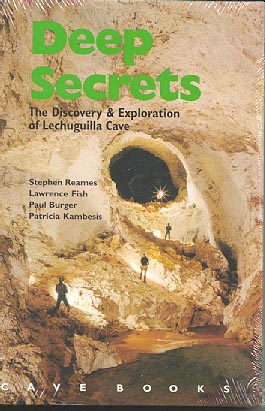 |
In 1986, a group of explorers dug through the floor of a small cave in the New Mexico desert to discover one of the most spectacular caves in the world. Lechuguilla Cave quickly gained national attention for its stunningly beautiful passages, deep pits, and scientific wonders. Cavers from all over the world swarmed to explore the cave, and over the next ten years, more than fifty miles of passage were discovered in Lechuguilla.
This is the story of discovery, danger, and adventure, and of the cavers who explored the cave. It is also a story of politics, conflicts, and intrigues as various individuals vied to control the exploration. And in the midst of it all is the rescue of an explorer whose leg was broken by a falling boulder over a mile underground. More than a hundred cavers cooperated to complete four days of transport through narrow crawlways and up immense pits to remove her from the cave.
Lechuguilla Cave has been featured in The National Geographic Magazine, in The Smithsonian Magazine, and in a National Geographic video. Here, for the first time, is the complete story of the trials and triumphs of the Lechuguilla Cave explorers.
"The discovery and early exploration of Lechuguilla is THE great adventure story of the current generation of cavers. Deep Secrets tells that story in rich, intimate detail, caver to caver, reveling in the glory and beauty of a truly amazing underground wilderness. It will leave you breathless."
"I am not a caver, but I was fascinated by Deep Secrets. The excitement, thrills, technical complexity, and political intricacy of the exploration and mapping of Lechuguilla Cave makes for an adventure that covers the full range of human ingenuity, perseverance, physical stamina, competition, and cooperation."
"In Deep Secrets the authors give us a true insider's view of the biggest discoveries, the dramatic episodes, and the political battles surrounding Lechuguilla . . . .
"As the story unfolds, we are witness to the most sensational discoveries and the thrill of exploration as Lechuguilla becomes longer, deeper, and more spectacular. We come to know the explorers themselves, share in their triumphs and frustrations. And we hold our breaths in suspense at the dramatic rescue of an injured caver miles underground . . . . Deep Secrets is a thoroughly enjoyable reading for nature aficionados, adventure enthusiasts, or anyone who just likes a good story."
Marian McConnell. 1999. 173 pp.16 illustrations by the author.ISBN 0-939748-49-5 $19.95 hb (Cover)ISBN 0-939748-48-7 $10.95 pb |
 |
Emergence is the story of six women and a young girl who go on an overnight cave trip into Dragons Den, a Virginia cave full of delicate formations, sinuous underground passages, and a 100 foot waterfall to a lower level stream passage. Danielle and Nicole are the trip leaders. Accompanying them are Sydney, who is also an experienced caver, three who are going caving for the first time: Gabby, photographer; Lynne, mother of three; Melissa, nature lover; and finally Kate, Danielle's daughter, a veteran caver eight years old. After they drop the waterfall pit, three young men enter the cave and accidentally cause a rockslide that traps the women in the lower level of the cave. This fast moving story is about their struggle to escape the cave and find themselves.
"A riveting, enthralling, very well written adventure story that made me feel as though I were in the cave. I couldn't put it down."
"Emergence is not a book just for cavers . . . . It is a book full of adventure that will be devoured by any reader who enjoys a well told tale. For it is that: a good balance of excitement, characterization, scene setting, a believable story line, a well woven tapestry with all the different threads coming together to form a story that you'll want to read again . . . . It was simply fantastic."
Rondal R. Bridgeman and Karen B. Lindsley. 1991.62 pp., 25 photos.20 maps and illustrations.ISBN 0-939748-27-4 $7.95 pb (Cover) |
 |
South China Caves is a very informative and well illustrated report on the March, 1988, joint expedition of the Institute of Karst Geology, the Speleological Society of South China Normal University, and the Cave Research Foundation.
This report focuses on the high karst plateau in northern Guangdong Province, the slope mountain karst within southern Hunan Province, and the mature tower karst area in Guangxi Province of southern China. These areas are rich in caves and have the potential to contain the deepest caves in the world. An overview of the geology of these areas is included along with chapters that cover speleothems, cave fauna, cave management and conservation, karst management, and the background of modern Chinese speleology. Readers will also enjoy Michael Ray Taylor's lighthearted excerpts from his surface diary of the people and places of this area.
Numerous photos and detailed maps throughout the book add to the understanding of this little known area. Anyone with an interest in the cave and karst regions of the world will find this a welcome and needed addition to their library.
Michael Ray Taylor. 1996. 285 pp.15 photos.This is the original first edition hardback published by Scribner. $15.00 hb (Cover) |
 |
Those who long to set foot on unknown land have two choices: fly into outer space or head underground. Here, in Cave Passages, Michael Ray Taylor describes his exploration of the intricacies of caving and takes the reader to some of the world's deepest and most treacherous caves. He also examines the sport as a metaphor for our relationship to the natural world.
Taylor lavishly depicts some of the most hidden and gorgeous places on earth, as well as the intrepid men and women who dare to probe them. A highly trained caver, Taylor has ranged all over the world in search of new discoveries in the dark depths underground.
In vibrant and precise prose he evokes the perils and triumphs of a caver's craft, how it is always fraught with danger, and how it strengthens the human will. An adventure tale informed by astute scientific observation, a reading experience as crisp and forceful as an underground river, Cave Passages celebrates the exotic beauty of our last pristine wilderness and marks the debut of a rich and fresh voice in American nature writing.
"Exploration in the most truly profound sense. Or senses: the fascinating real labyrinth of underground, the subterranean part of the mind, and the probing sense of blind pure adventure. The reader comes up from the depths into a light that has changed forever, for the better and more mysterious."
"Caving exploits, some of them terrifying, elegantly described by Taylor . . . . details the winding road of his freelance writing career . . . but his true element is down under, with all its geological intricacies--latticeworks and crystals and rushing waterways--and with those curious souls at home in the netherscape. Mesmerizing."
"Michael Ray Taylor's haunting prose takes us into a private universe, a fantastic place of glimmering sanctuaries where strange creatures feed nutrients carried by the wind. Emanating like an ethereal geyser from a jumble of rock, that same wind might betray a hidden passage leading to even greater mysteries. Cave Passages is an extraordinary, profoundly spiritual book."
"Michael Ray Taylor takes us on an entirely immediate and compelling odyssey. Cave Passages reveals a primordial power so enthralling. I'm convinced that we do indeed, still carry cavemen inside us."
"Cave Passages is a well written book about the glories and dangers of caving. Michael Ray Taylor has a wry sense of humor and a keen eye. Recommended for both the curious and the hard core."
"Cave Passages is one of those rare books that travels down into the secret places of the world, down into dozens of memorable characters, down into nature, and down into language. Its revelations are constant. And Michael Ray Taylor's observations become part of the reader's tunnels, rooms, and hidden rivers of imagination."
This is the original Atheneum paperback edition. $9.95 pb
Donald Finkel is a distinguished American poet who has published over fourteen books of poetry. In Answer Back, he uses cave exploration as a metaphor to explore the inside of his own skull, and that of a friend said to be insane.
Donald Finkel is also the first and only poet ever invited to go to the Antarctic by the National Science Foundation. The result of this is the book length poem, Endurance: An Antarctic Idyll, in which Finkel deals with the story of Ernest Shackleton's attempt to land a transcontinental expedition on the coast of Antarctica and his ordeal after the ship was destroyed.
Endurance is bound as a double volume (you flip the book upside down) with Going Under, another book length narrative poem dealing with the history of the Mammoth Cave region. It is a true caver's poem. In the first section, Stephen Bishop is invoked as the reader's guide through Mammoth Cave. In the second section, Floyd Collins is followed through Great Crystal Cave to his death in Sand Cave. In each of these long poems, Finkel tells stories of adventure as only someone who has been an adventurer himself and is also a grand poet can do.
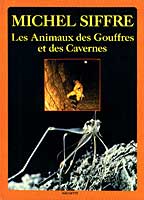
Michel Siffre. 1979. 117 pp.67 color, 39 b/w photos.This is the original Hachette hardback edition. $9.95 hb (Cover) |
 |
Michel Siffre is one of the world's most distinguished speleologists. In 1962, he spent 58 days in complete temporal isolation in the Gouffre du Scarasson in the Maritime Alps of France, starting thereby a sequence of experiments in sleep wakefulness and the drift of circadian rhythms in human beings. These experiments continue to the present day. In free running systems such as caves, with no time clues and no contact with the outside world, the day-night rhythm of subjects has stabilized at 12-24 and even 20-52 hours. The application of the results of this work to space exploration is obvious.
Siffre is also the author of a dozen important books on caves and caving. Les Animaux des Gouffres et des Cavernes is one of these. It contains chapters on the history of biospeleology, the subterranean environment, how animals live under the earth, on cave animals and cave plants, and on cave pollution. Although the book is written in French, it will be of interest to readers of English because of the 106 photographs of underground life, most of them in full color. If for nothing else, it is worth the price as a diversionary coffee table book. This is a book that opens a new world for anyone who glances through it.
|
Download Price Sheet |
